Vision
Utilizing degraded lands and brackish water for growing plants of
economic importance to reduce pressure on fertile lands and sweet
water resources.
Mission
Domesticating various halophytes to serve as a source of fodder, forage,
biofuel, oil seeds, medicinal plants and other possible usages.
Rationale behind establishing the Institute
A significant portion of the Earths surface is affected by salinity, with
nearly three-quarters covered by saline water bodies and vast areas of land
degraded by natural and secondary salinization. In many regions, subsoil water
is of poor quality and unsuitable for conventional agriculture. The expansion
of agricultural land and the search for new freshwater resources pose serious
ecological and practical challenges, making traditional approaches increasingly
unsustainable.
These constraints highlight the need for alternative strategies to support
food and resource security for a growing population. One promising solution
lies in the utilization of halophytes - plants naturally adapted to saline
environments found in degraded and marginal lands.
Recognizing the untapped potential of these plants, the MAK Institute of
Sustainable Halophyte Utilization was established in 2006 with the support of
the University of Karachi and the Higher Education Commission of Pakistan.
The Institute is dedicated to advancing research on halophytes for sustainable
use of saline resources.
Research at ISHU focuses on understanding salt tolerance mechanisms through
an integrated approach combining eco-physiology, biochemistry, genetics,
and molecular biology. The Institute has made significant contributions to
saline agriculture, trained faculty and researchers through national and
international collaborations, and produced highly qualified postgraduate alumni
serving in leading academic and research institutions.
To date, over 30 M.Phil. and Ph.D. scholars have graduated from the Institute.
The Institute’s research excellence is demonstrated by more than 500
international peer-reviewed publications, securing its prominent position
within the University of Karachi.
Postgraduate Programs Available
M.Phil. & Ph.D, in Botany (ISHU)
Avenues for Research
- Plant Ecology and Ecophysiology
- Biochemistry and Biotechnology
- Photosynthesis and Photobiology
- Ecotoxicology and Phytoremediation
- Phytochemistry of Medicinal Halophytes
- Halo-fuel and Saline Agriculture
- Genomics, Transcriptomics and Proteomics
Aims and Scope of the programs
The major objectives of the degree programs at MAK-ISHU are:
-
To create awareness about the pristine and dynamic salt
marsh and salt desert ecosystems, their direct economic,
ecological and aesthetic benefits of halophytic communities
for mankind and the need for conservation.
-
To infuse realization about the challenges of global climate
changes, their impacts and the need to develop indigenous and
innovative ways to harness conventional and non-conventional
future crops in an environment friendly manner.
-
To train students in cutting-edge research techniques for
investigating the dynamic stress tolerance mechanisms of stress
tolerance of plants.
These postgraduate programs are in line with several
United Nations Sustainable
Development Goals
(SDGs), particularly SDG 2 (Zero hunger), SDG 7 (Affordable & clean
energy), SDG 11 (Sustainable Cities and Communities), SDG 12 (Responsible
Consumption and Production), SDG 13 (Climate Action), SDG 14 (Life in Water)
and SDG 15 (Life on Land).
Facilities Available
ISHU has state of the art facilities for conducting research in lab,
green-houses and an experimental field conditions. Salt tolerant plants have
the potential to become nonconventional future crops which may be utilized
as food, feed, fiber, medicines and ornamentals. Instruments such as Atomic
Absorption Spectrometer, CNS analyzer, GC-MS, HPLC, Ion Chromatograph, Gel
Doc System, PCRs, Li-COR Photosynthesis system, Walz PAM fluorometer,
Osmometer and Plant Water Status Console are available.
Infrastructure
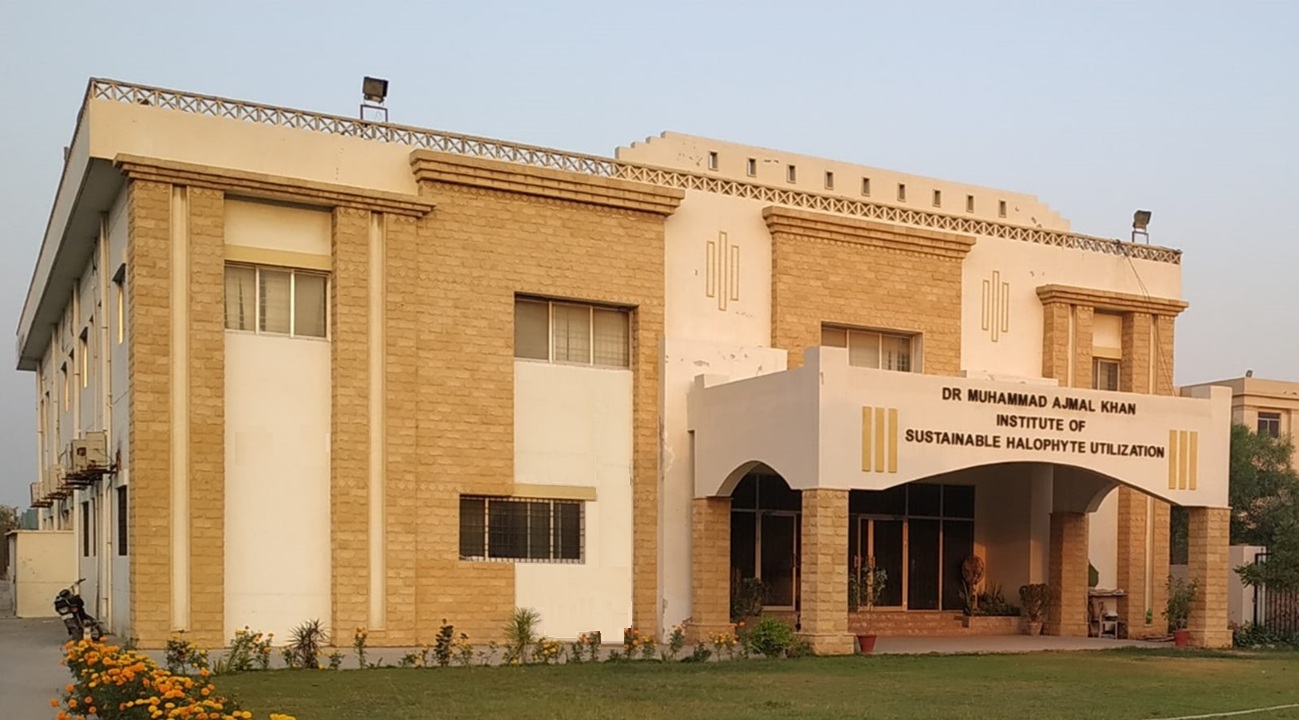
The Institute has the state-of-the-Art facilities with six offices and four
working laboratories on the ground floor including an instrument lab, with
ten additional working labs on the first floor. The institute also has two
conference rooms, a cold room and three netted green houses in the premises
for conducting growth experiments.
Career Opportunities
ISHU graduates can apply for teaching positions in public and private
teaching and/or research institutions as well as in research and
development organizations related to plant sciences.
|